Single-cell RNA Seq on DNBSEQ-T1+ Using Bio-Rad ddSEQ 3’ RNA-seq Kit
Introduction
Single-cell RNA sequencing (scRNA-seq) has transformed the study of complex tissues by resolving cellular heterogeneity, transient states, and lineage trajectories that are obscured by bulk approaches [1]. As single-cell studies scale from thousands to millions of cells, sequencing workflows must deliver sensitivity to low-abundance transcripts, multiplet and crosstalk control, flexible throughput, and cost-efficient scalability.
The Bio-Rad ddSEQ Single-Cell 3’ RNA-Seq Kit is a droplet-based workflow that uses barcoded beads with deconvolution oligos to maximize usable cell recovery. It supports 500–10,000 input cells or nuclei, enables same-day cDNA and deconvolution-oligo library generation with multiple safe stopping points, and includes open-source Omnition analysis for rapid QC and reporting.
The Complete Genomics DNBSEQ-T1+ sequencer, powered by DNBSEQ™ technology, provides flexible mid-throughput sequencing with high Q40 accuracy and output ranging from 50Gb to 1.2Tb in under 24 hours.
Methods
Sample and Library Preparation
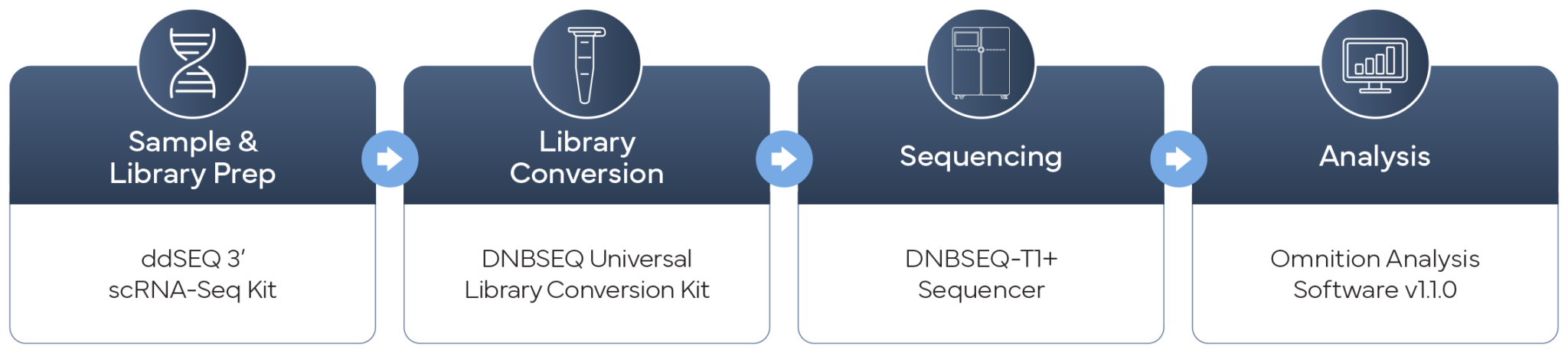
Multiple independent experiments were performed using A375, A549, and mixed-species HEK293/NIH 3T3 samples loaded onto the ddSEQ Single-Cell Isolator at various target outputs. Libraries were prepared with the ddSEQ 3’ scRNA-Seq Kit, generating cDNA and deconvolution oligo libraries, both containing P5 and P7 adapters for dual-indexed paired-end sequencing.
Library Conversion and Sequencing
ddSEQ 3’ scRNA-seq libraries were split for sequencing on the Complete Genomics DNBSEQ-T1+ and Illumina NextSeq 2000 platforms. For DNBSEQ-T1+ sequencing, libraries were converted to single-stranded circles using the DNBSEQ Universal Library Conversion Kit. cDNA libraries were converted individually, while DO libraries were pooled before conversion. Resulting cDNA and DO DNA nanoballs were pooled with a 35% standard-library spike-in to ensure base diversity and sequenced on the DNBSEQ-T1+ using the High-Throughput Sequencing Reagent Set, FCL PE150.
Analysis
FASTQ files from both platforms were analyzed with Omnition Analysis Software v1.1.0 using default parameters. DNBSEQ-T1+ FASTQ filenames were modified for Omnition compatibility. Sequencing data were downsampled to 40,000 or 50,000 reads per cell for comparison, and tertiary analyses were performed using Seurat v5.0.3